

- Starring
- Toni Servillo, Anna Ferzetti, Orlando Cinque
- Writer
- Paolo Sorrentino
- Director
- Paolo Sorrentino
- Rating
- R (United States)
- Running Time
- 133 minutes
- Release Date
- February 6th, 2026 (MUBI)
Overall Score
Rating Summary
In the modern Italian cinematic landscape, writer-director Paolo Sorrentino looms large and is one of the most significant names in the local industry. The Neapolitan director has made films like The Great Beauty, which won the Academy Award for Best Foreign Language Film, as well as works like Parthenope and The Hand of God. With such a lauded track record behind him, each subsequent project of the filmmaker attracts attention from the many of the major European film festivals, most prominently the Cannes Film Festival, where Sorrentino is a regular. Following a subpar effort in Parthenope, a film which would go on to receive the worst critical reaction from the 2024 Cannes Film Festival competition slate. However, his latest, La Grazia, marks a return to form for the filmmaker, going back to his political roots.
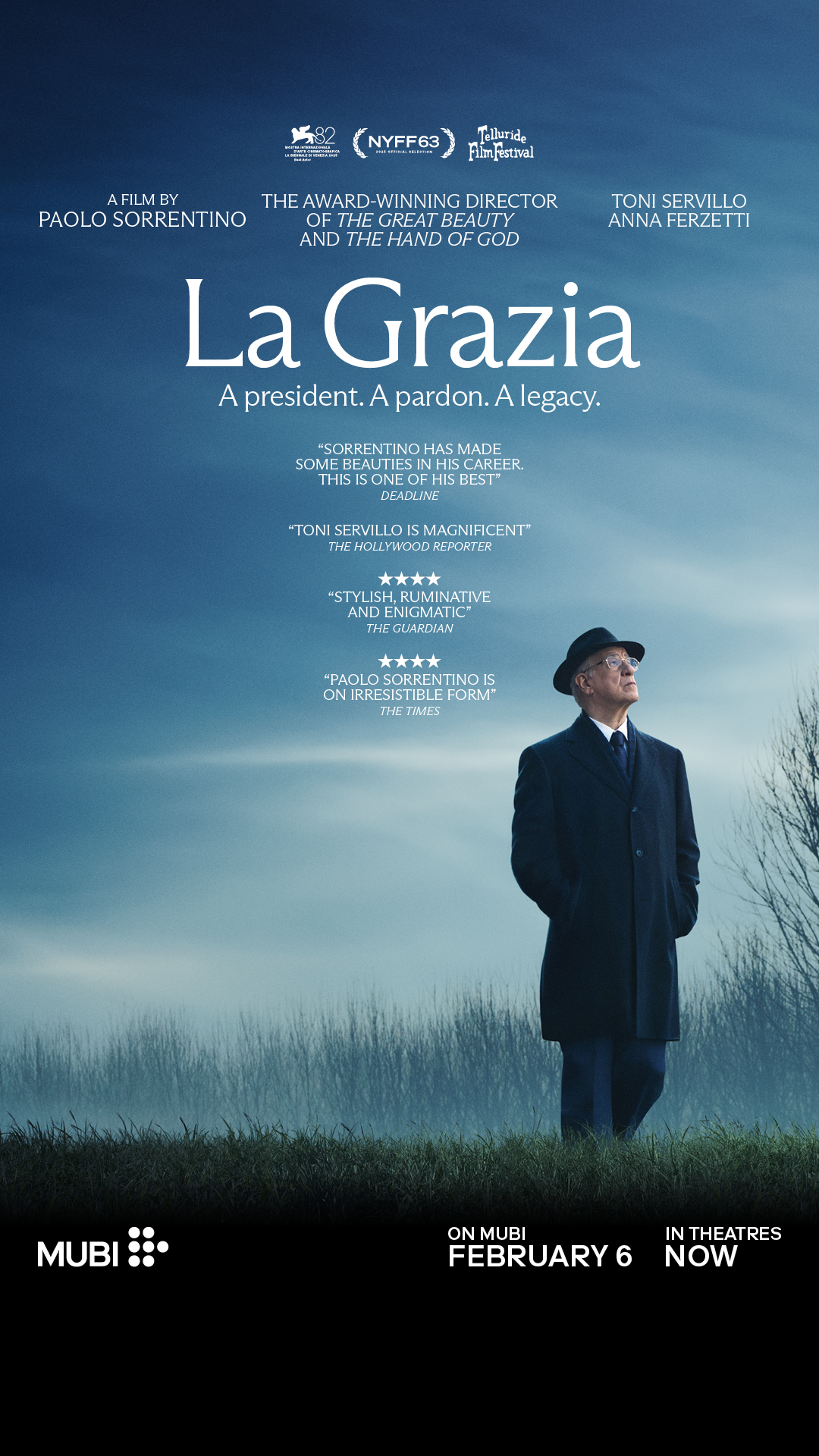
Teaming up once again with actor Toni Sevillo, their seventh collaboration tells the story of Mariano De Santis (Sevillo), Italy’s President. Ending his mandate, he found himself in mourning, following the death of his late wife, eventually vacating the seat for another political figure. That being said, before he leaves the position, De Santis is forced to analyze the presidential pardons of two individuals convicted for murdering their respective partners, as well as the legalization of euthanasia. As De Santis approaches the latter days of his presidency, weighing the consequences of those pardons and the legalization of euthanasia, he must do amidst the sensitivities of a catholic country. Meanwhile, his relationship with his legal advisor and daughter Dorotea (Anna Ferzetti), also played a role in that dilemma. Above all else, the film is about the trajectory of a man ready to retire and leave behind the weight of an entire country.
To set the stage, the film introduces an element fundamental to Sorrentino’s cinema: the magnitude of architecture. Similar to The Great Beauty, the director centers his characters in impressive buildings that contrast their inutility to the world compared to the impressiveness of those constructions. Though despite the importance of his title, De Santis is a minimal figure compared to the enormous palace in which he resides. Production designer Ludovica Ferrario assembles a visual feast for cinematographer Daria D’Antonio, masterfully capturing the scope of the presidential palace. Narratively, it symbolizes the weight of responsibility; De Santis is always tense when walking those large corridors. However, in his small flat, the former president finds comfort, a well-utilized element by Ferrario.
Still, the most vital aspect of Sorrentino’s films is his muse: Toni Sevillo. As always, he shines in the skin of a bureaucrat. Through his performance, he embodies the spirit of a long-gone Italy, one that rebuilt itself after the destruction of World War II and continues to deal with the aftermath of the 2008 financial crisis and the Berlusconi years. His approach to De Santis is to bring to life the kind of conservative character who is attentive to the individuals around him. However, Sorrentino’s return to the political arena has little to offer other than the charisma of Sevillo. As a result, the film feels flat in spite of a performance that carries so many of the director’s ideas; however, it does not offer much beyond the acting masterclass from a living Italian legend.
With La Grazia, Paolo Sorrentino presents another of his political captures of Italy. Beneath a masterful performance by Toni Sevillo and the visual impressiveness of Daria D’Antonio’s cinematography, there is no strong core to organize his political commentary. Still, the film is a return to form by one of the most crucial Italian filmmakers of our era.
still courtesy of MUBI
If you liked this, please read our other reviews here and don’t forget to follow us on Twitter or Instagram or like us on Facebook.

Brazilian film writer. He is also a producer and executive producer for Zariah Filmes. Member of the International Film Society Critics Association (IFSCA), International Documentary Association (IDA), and Gotham and Media Film Institute.
Discover more from
Subscribe to get the latest posts sent to your email.