
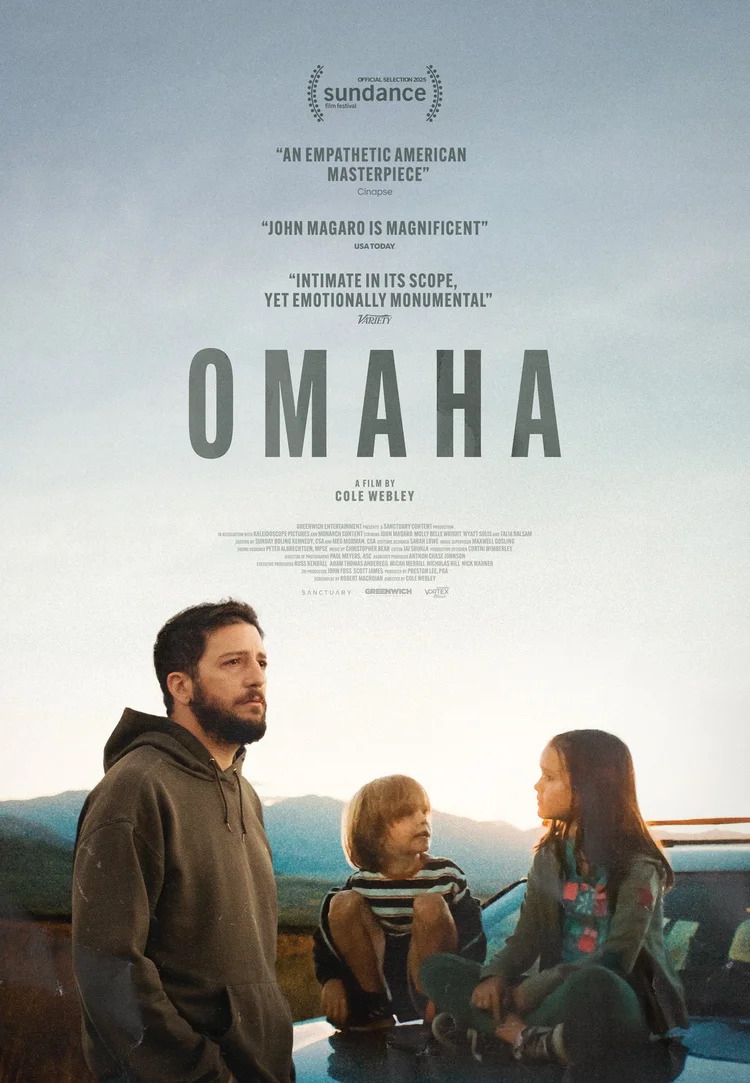
- Starring
- John Magaro, Molly Belle Wright, Wyatt Solis
- Writer
- Robert Machoian
- Director
- Cole Webley
- Rating
- PG (Canada), PG-13 (United States)
- Running Time
- 83 minutes
- Release Date (US)
- April 24th, 2026
- Release Date (CAN)
- May 8th, 2026
- Release Date
- June 5th, 2026 (VOD)
Overall Score
Rating Summary
Omaha is certainly not the first film to depict struggles in the wake of the widespread economic recession of the late 2000s. Undoubtedly a tricky topic, showing those at their most vulnerable and struggling to get by, there is a risk of it cooking off as insensitive or offensive to those living through it. The key is to make characters feel like real people, with depth and personality, living through real situations. Omaha follows a father (Magaro) going on a cross-country trip to Omaha, Nebraska with his two children, after losing their home. However, it is clear that he’s not being completely transparent with his children (or with audiences) about the real reason for this trip. Despite the premise, a film that is clearly supposed to elicit deep emotions from audiences, several out of place beats throughout the story get in the way of this goal, despite being surrounded by brilliant performances.
A very slight film, it is not loud or boisterous, rather, it presents its story in a very quiet and calm manner as the family goes from one stop to the next on their journey. Its ultimate success will likely rely on the buy-in on for this slower paced story, making audiences a fly on a wall across the characters’ journey. Keeping things loose and light, audiences will need to wait until the later stages of the film to get any payoff, as all the pieces start to come together. While this method of storytelling brings a good level of immersion, it also can keep audiences at a distance from the characters. At times, the characters, particularly the father, can feel emotionally detached, making them difficult to connect to. This issue can be seen from the start, with the father not getting a formal name. That being said, it is easy to empathize with the characters’ situation, the father’s struggles to raise his two kids after the death of his wife are clear, however, the film fails to offer much else for audiences to connect with the characters in a meaningful way.
The story works best when the focused is on the POV of the father’s young daughter Ella (Wright), showing her notice her father struggling to keep it together. Alternating in and out of her POV doesn’t completely work, mostly because seeing the film from the daughter’s perspective, when audiences have been kept mostly in the dark as she has, is when the film is at its strongest. Seeing Ella slowly realize that something is wrong, but not knowing what it is feels crucial to the story. It shows that kids see a lot more than parents think, even if they believe they’re hiding it really well.
Despite the subject matter, the film remains underwhelmingly emotional. One might think that it would deeply resonate, considering the subject matter, however, it felt the opposite. The issue with the emotional aspect of the film was the ending’s lack of a natural conclusion. Rather than the ending fitting naturally into the story, it feels as if it exists solely to emit an emotional response from the audience. While this isn’t inherently a bad thing, oftentimes this can come at the sacrifice of maintaining the momentum of the story. It’s treated as a twist ending rather than one that’s trying to talk about the intersection of this decision and the poverty and struggle of everyday Americans at the time. Though a better solution was there, its execution here just failed to land.
Despite all the issues of the film, its cinematography and performances are certainly its highlights. Filled with beautiful shots of the Utah landscape, calm and serene scenery contradict the harsh reality of the story. Magaro is great here as the family patriarch, showcasing a father trying his best to not break down completely in front of his kids, clearly struggling but trying to keep it together for their sake. However, it’s Wright who is the clear standout here as Ella, holding her own against a seasoned actor like Magaro. She perfectly showcases a daughter who understands that something is wrong, but has no idea what. Showing that children understand more than people might think.
While, Omaha is not a bad film by any means, it is certainly not the best film at showcasing this recession-era struggle in a real and meaningful way. Thanks to a late film plot twist, it is hard to figure out what audience are supposed to take away here. Was it just to learn about the events that clearly inspired this film? Just to showcase the hard decisions some parents had to make in the midst of financial and personal hardships? It remains unclear. Despite this, the performances absolutely make it work, with Magaro and Wright playing off each other so well as father and daughter, even if the film is not as emotionally strong as it feels like it should have been, it is still a moving portrayal of the hardships families faced during the recession (if you ignore the last thirty minutes).
still courtesy of Vortex Media
If you liked this, please read our other reviews here and don’t forget to follow us on Twitter or Instagram or like us on Facebook.

Discover more from
Subscribe to get the latest posts sent to your email.