

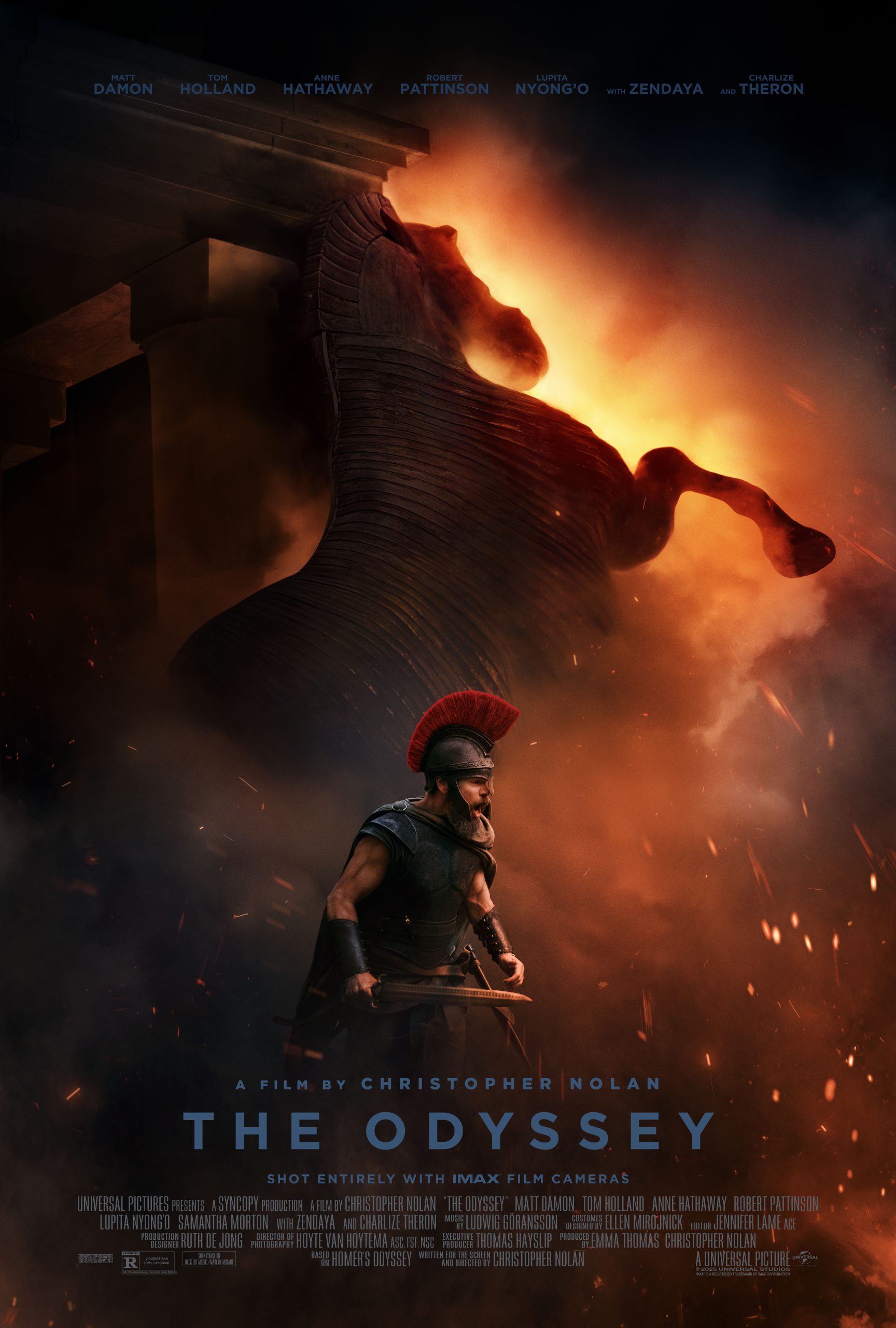
- Starring
- Matt Damon, Tom Holland, Anne Hathaway
- Writer
- Christopher Nolan
- Director
- Christopher Nolan
- Rating
- PG (Canada), R (United States)
- Running Time
- 172 minutes
- Release Date
- July 17th, 2026
Overall Score
Rating Summary
For a long time, if you asked casual moviegoers to name the greatest living director in Hollywood, the answer was almost always Steven Spielberg or Martin Scorsese. Their contributions to cinema are indisputably monumental, and their filmographies are packed with enduring classics and have received virtually every accolade imaginable. It seemed almost impossible for any Hollywood filmmaker to catch up to their legacies while they were still actively making films.
Christopher Nolan has been a household name ever since he reinvented the Batman franchise and redefined what superhero films could be, helping catapult the genre into the cultural sensation it was throughout the 2010s. Over the past few years, however, he’s reached an entirely different level. Oppenheimer was a once-in-a-generation achievement; a film that succeeded on every front and will likely be spoken of in the same breath as The Godfather, Citizen Kane and There Will Be Blood as one of the greatest cinematic achievements of all time. It earned universal critical acclaim, became a massive box office phenomenon that far exceeded expectations, and dominated the Academy Awards, finally earning Nolan the Best Director and Best Picture victories that had long seemed overdue. He now firmly belongs in the same conversation as Spielberg and Scorsese, and you would be hard-pressed to find many cinephiles willing to argue otherwise.
How does one follow a film as monumental and era-defining as Oppenheimer? With the creative freedom to pursue virtually any project he wanted, Nolan chose one of the most ambitious challenge imaginable. He turned to one of the oldest and most revered works of literature ever written, setting out to create the definitive cinematic adaptation of The Odyssey. In a year packed with long-awaited cinematic events, The Odyssey stands above them all as perhaps the event of the year. The anticipation has been unprecedented, with 70mm IMAX screenings selling out nearly a year in advance. Given that level of excitement and the opening weekend tracking, the film is almost certainly going to surpass Oppenheimer at the box office and will likely sail past the billion-dollar mark, becoming Nolan’s highest grossing film to date.
The Odyssey features an all-star ensemble led by Damon as Odysseus, the legendary King of Ithaca. After winning the Trojan War, Odysseus and his men begin their journey home, only to find themselves trapped in a decade-long odyssey shaped by the whims of the gods. Along the way they encounter legendary figures including the Cyclops Polyphemus (Bill Irwin), the Sirens, the Hydra, and the nymph Calypso (Charlize Theron), while Odysseus desperately fights to return to his wife, Penelope (Hathaway), and his son, Telemachus (Holland). Running parallel to his journey is the story of his now-grown son. Having no memory of his father, Telemachus refuses to believe the rumours that he is dead and embarks on a journey to find him. Meanwhile, Penelope struggles to hold Ithaca together while fending off an endless parade of suitors, chief among them the manipulative Antinous (Robert Pattinson). With no king to lead them, the kingdom grows increasingly unstable as rumors spread of mysterious “Sea People” preparing to invade Ithaca and seize the throne. Nolan weaves these narratives together beautifully, exploring not only the classic hero’s journey but also the devastating consequences that war and ambition have on both the people who fight beside a hero and the family waiting for him at home.
The film possesses a sense of scale that very few filmmakers are capable of achieving. It feels like genuine event cinema, filled with sequences that leave audiences gasping at both their spectacle and the sheer technical craftsmanship on display. The Odyssey has long been considered one of literature’s most difficult works to adapt, and it’s easy to understand why. Not only must a filmmaker capture the enormous scope of the story, but they also have to reconcile its grounded human drama with its wildly fantastical mythology. Nolan is primarily known as a science fiction filmmaker and has never been one to embrace whimsy, therefore, there was still the question of whether or not he could convincingly embrace creatures, gods, and mythological spectacle. Thankfully, he does. The Odyssey carries a genuine sense of magic without ever abandoning the grit that defines his filmmaking. The encounters with Polyphemus and the Hydra are breathtaking, among the most visually astonishing sequences Nolan has ever directed. Rather than simply recreating these iconic creatures, he finds fresh, imaginative ways to portray them while preserving their mythic grandeur.
Another other question going in, was the cast. Featuring so many recognizable, modern A-list stars, one can’t help but wonder whether they would fit this time period. Damon delivers one of his strongest performances in years. Odysseus is a physically demanding role that requires him to carry enormous action set pieces while also conveying the emotional burden of a man desperate to return home to the family he left behind. Here, he brings warmth, vulnerability, and gravitas, making his longing for Penelope and the son he barely knows genuinely affecting. If there is one issue with Odysseus, it is how the film doesn’t always explore his flaws as deeply as it could. Other characters frequently criticize Odysseus for his reckless pursuit of glory and the devastating consequences his decisions have on the men who follow him, yet Damon’s portrayal rarely allows that arrogance or moral ambiguity to fully surface. He remains almost unwaveringly heroic, where a little more darkness or edge might have made the character more complex.
Holland arguably entered the film as its the biggest question mark. Outside of Spider-Man, many of his leading roles have failed to resonate with critics or audiences, leaving some uncertain about whether he’ll remain a movie star once he’s done with his gig as Peter Parker. In this case, he rises to the occasion beautifully. While Telemachus still possesses some of Holland’s trademark boyish charm that gets him typecast as young, innocent characters, this is a far more demanding performance than audiences may expect. He commands the screen with confidence, gives the character emotional depth, and shares wonderful chemistry with John Leguizamo, who is nearly unrecognizable in one of the film’s strongest supporting performances.
Hathaway is equally excellent as Penelope, delivering some of the film’s most emotionally devastating moments and reminding audiences what a gifted dramatic actor she is. She has several powerful monologues that give her enough showcase moments to emerge as a Best Supporting Actress contender for a nomination, especially given the incredible year she’s been having. Pattinson is perfectly cast as the smug, manipulative Antinous, injecting the film with some much needed humor, while remaining genuinely threatening. Samantha Morton also leaves a lasting impression in a brief but unforgettable supporting role as Circe, transforming the film into full-blown horror movie during one particularly chilling sequence as a witch that Odysseus and his crew encounter.
Much has been made of the fact that Nolan works with arguably the best creative team in the industry today, and The Odyssey is perhaps the finest showcase yet of what they’re capable of accomplishing together. The film marks an extraordinarily ambitious undertaking, yet every aspect of the production comes together seamlessly. Hoyte van Hoytema continues to prove why his partnership with Nolan is one of the defining director-cinematographer collaborations of modern cinema. Few cinematographers are pushing the boundaries of filmmaking technology the way he is. Shooting an entire feature on IMAX film is an extraordinary technical achievement in itself, and the format gives The Odyssey a scale that feels genuinely overwhelming. Sequences like the Trojan Horse infiltration play out almost like magic tricks. It’s hard to imagine how Nolan and van Hoytema manage to capture some of these shots. The production design, costume design, and sound are equally breathtaking, immersing the audience in a world that feels both historically authentic and mythically grand.
Ludwig Göransson once again delivers an exceptional score. Rather than relying on memorable melodies in the way he has thus far in his career, his latest is more focused on building atmosphere and tension, crafting music that enhances the film’s sense of awe and mystery without ever overpowering it. It works exceptionally well in the film, but is one that many audiences are unlikely to regularly listen to outside of the context of the film.
If it had any big flaw, it would be how the screenplay occasionally features lines of dialogue that feel oddly contemporary for the period and completely out of place. For the most part, Nolan strikes an impressive balance between making this ancient text accessible to modern audiences while preserving its mythic setting. Every so often, however, a line lands with a noticeably modern sensibility, briefly pulling the audiences out of the experience and even drawing a few unintended laughs. Fortunately, these moments are rare and never come close to undermining what is otherwise a masterfully put together film.
Overall, The Odyssey is exactly what audiences have been hoping for. It is a staggering technical achievement, a thrilling adventure, and one of the most immersive cinematic experiences Nolan has ever created. Magical, awe-inspiring, and relentlessly ambitious, it stands as another reminder of what Hollywood filmmaking can achieve at its absolute best.
still courtesy of Universal Pictures
If you liked this, please read our other reviews here and don’t forget to follow us on Twitter or Instagram or like us on Facebook.

Discover more from
Subscribe to get the latest posts sent to your email.
