

- Starring
- Haruka Ayase, Daigo Yamamoto, Rimu Kuwaki
- Writer
- Hirokazu Koreeda
- Director
- Hirokazu Koreeda
- Rating
- PG (Canada, United States)
- Running Time
- 126 minutes
- Release Date (US)
- July 24th, 2026 (limited)
- Release Date (CAN)
- July 31st, 2026
Overall Score
Rating Summary
Hirokazu Kore-Eda is one of the most crucial Japanese filmmakers of our time. He has won the Palme d’Or at Cannes for 2018’s Shoplifters, a film about a family attempting to survive in Japan. His films are well-known for their emotional core, mostly stories about children, such as Nobody Knows and Monster. As a whole, his films are about the humanity in people, the possibility of connections, and the consequences of affection. In recent years, he has gained widespread distribution in North America with his recent efforts, including Broker, the aforementioned Monster, and now his latest, Sheep in the Box.
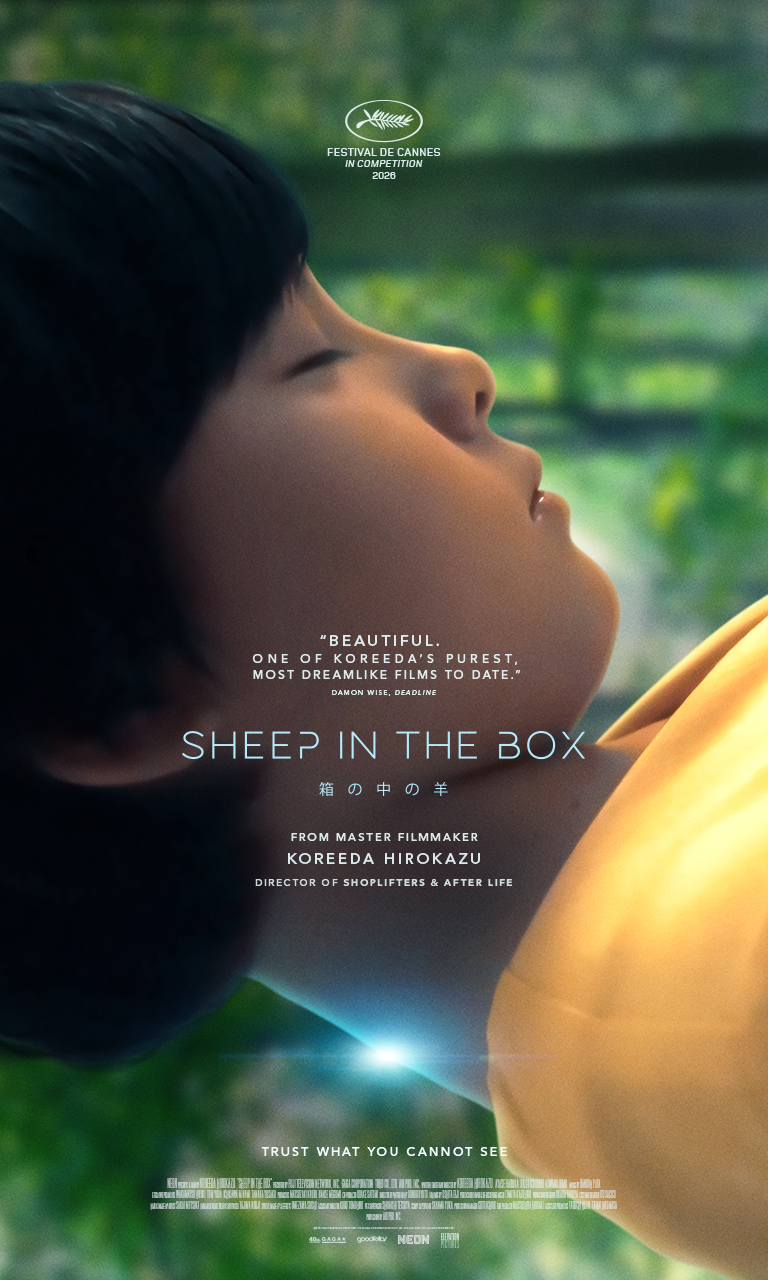
Set in a near future, the story follows a couple, Otone (Ayase) and Kensuke (Yamamoto), who mourn the loss of their son, Kakeru (Kuwaki Rimu) – a victim of a kidnapping which the police could not solve. Today, the pair live with the pain of losing their only child, while attempting to live on with their lives; she is an architect, and he is the owner of a construction company. However, one day, they receive an advertisement for a new company that replicates humans in humanoids, allowing families to live with their loved ones again. From there, the couple decides to acquire an artificial human of their own, hoping it could help alleviate their pain.
In awe of the discussions about artificial intelligence and its use for digital necromancy, Kore-Eda designs a science fiction that follows the humanism of his oeuvre. In this sense, the Japanese master tackles necromancy lightly in the digital era, similar to the classic stories of amassing someone’s loss over the substitution. In multiple moments, the characters around Otone mention the necessity of moving on. They talk about the tree they planted with the kid, and that they should go away; also, the importance of returning the humanoid to heal gradually over time. At its core, the film sees Kore-Eda remain the same in his messages about humanity over technology, which mirror the emotional complexity of a human being. It is clear and direct in the film’s formatting. However, the execution of this messaging only served to diminish the film’s impact.
On a technical level, the cinematography, by his usual partner Ryuto Kondo, offers audiences an utterly bright look that showcases the artificiality of the premise. On the other hand, the film has an overly-lit look that, while fascinating as a creative choice, expands its strangeness. Unlike in his past works, such as Shoplifters, Sheep in the Box fails to nail the emotional nuance necessary for a discussion on grief. It sounds too bureaucratic and shallow, and does not land on an emotional core allowing the audience to care and develop a deeper emotional connection with these characters. Indeed, Ayase does a good job as a grieving mother, but the script frames her in a unidimensional light.
In the end, the humanist core of Kore-Eda’s career is absent from his latest effort, Sheep in the Box. Consequently, the polish and restraint of its discourse result in an uninteresting and monotone film that fails to dive into discussions of AI and digital necromancy. While there are glimpses of Kore-Eda’s filmmaking here, they are not enough to make his latest coherent.
still courtesy of Neon
If you liked this, please read our other reviews here and don’t forget to follow us on Twitter or Instagram or like us on Facebook.

Brazilian film writer. He is also a producer and executive producer for Zariah Filmes. Member of the International Film Society Critics Association (IFSCA), International Documentary Association (IDA), and Gotham and Media Film Institute.
Discover more from
Subscribe to get the latest posts sent to your email.