

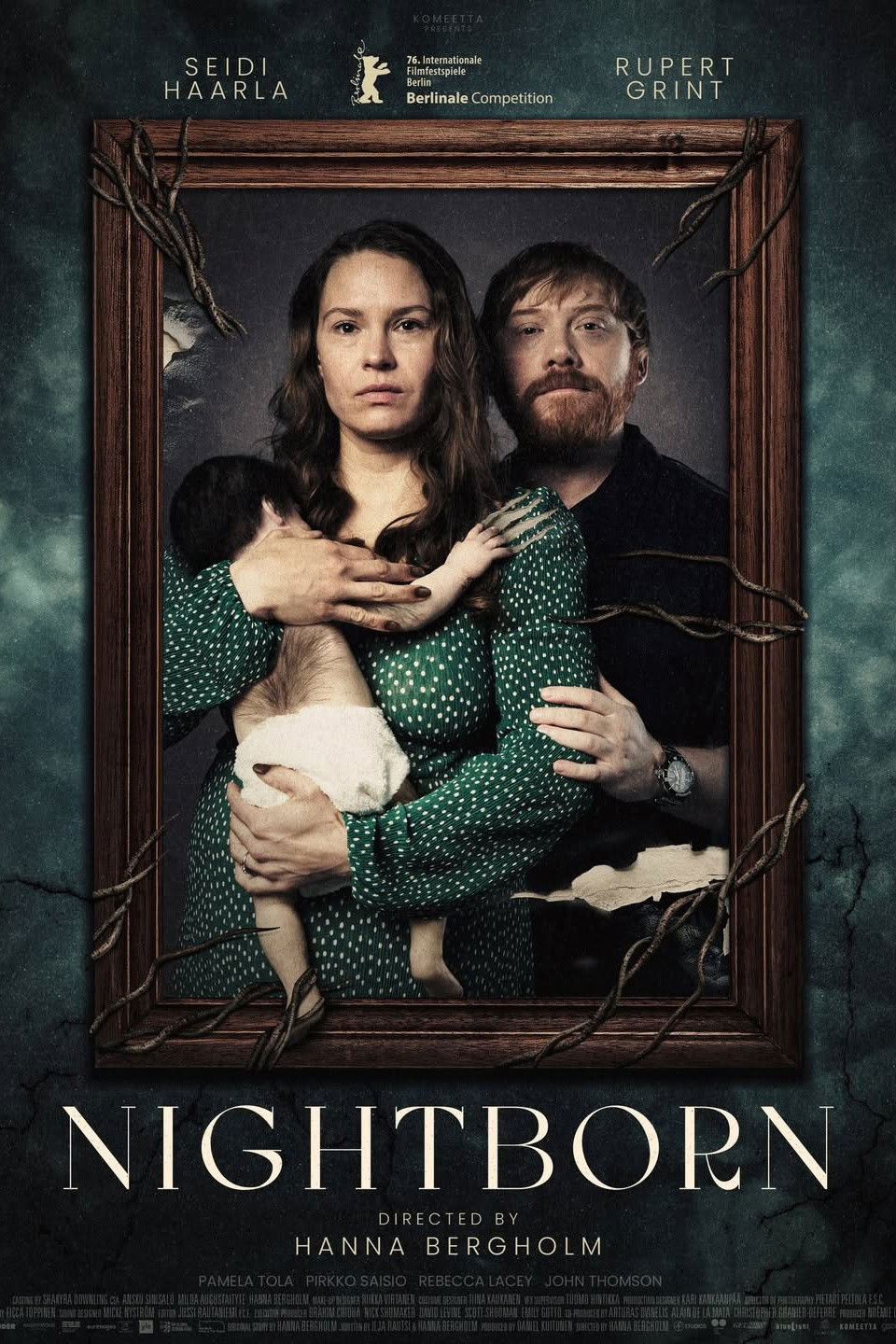
- Starring
- Rupert Grint, Seidi Haarla
- Writers
- Hanna Bergholm, Ilja Rautsi
- Director
- Hanna Bergholm
- Rating
- n/a
- Running Time
- 92 minutes
- Release Date
- July 31st, 2026 (Shudder)
Overall Score
Rating Summary
Directors have experimented with genres and different cinematic approaches to tell stories about motherhood. Films like ‘We Need to Talk About Kevin’, ‘Die My Love‘, and ‘Mother!‘ frame the difficulty of raising a child; with some tackling the subject of postpartum depression. In 2022, Finnish director Hanna Bergholm made a splash at Sundance with her debut ‘Hatching‘, an intriguing film about the familial dynamic. Four years later, she takes the leap from the American festival to one of the three most prestigious events in the world, the Berlin International Film Festival. Her sophomore effort, Nightborn, had its world premiere at this year’s edition, a film that sees the writer-director return to the theme of familial connections through the lens of horror.
Nightborn is centered around the relationship between a Finnish woman named Saga (Haarla), and a British man named Jon (Grint). Moving to Saga’s childhood home deep in the Finnish woods that, after many years, shows considerable signs of wear and tear. Therefore, in order for them to move forward with their lives, the couple needs to restore it to make it their home. In the meantime, Saga gets pregnant and after a traumatic birthing experience, starts to believe that something is wrong with her baby. Suddenly, to her, everything felt out of place, as this process looked to take a toll on Saga. Feeling the pressure of her new position, this was reflected in a psyche that grew more fragile over time.
From the start, the film is utterly quick to introduce Saga and Jon’s drama. Within a few minutes, Saga gives birth and suffers from a dilaceration that threatened her physical health. Bergholm chooses graphic imagery to set the tone; audiences observe the baby’s head smashing her pelvic area, and blood splashing in the camera’s direction. In a sense, the film boasts a picturesque visual tone, a fable that is similar to the filmmaker’s visual tone in her debut. Similarly, set designer Kari Kankaanpää is responsible for creating a maze for these characters, walls that mentally abuse them. The baby’s room has a wide angle; it is an open space that feels like an ancient dollhouse, utterly chic and classy. Yet, the director introduces the gory elements to the baby’s body or the animalistic urge to feed livestock blood to him.
Consequently, Bergholm is very clear on her intentions as an artist. The delicate scenarios are opposed to the imaginary of motherhood, the airy memorabilia, and baby clothes. In contrast, the surroundings are tight, but the core is dirty, ugly. Therefore, Haarla works well as an individual losing her individuality and sanity to protect this new creature. She despises him, even referring to the baby as ‘it’, but hates being pregnant, even despising herself. Meanwhile, she does an admirable job adding a physicality to her performance. That being said, the other characters feel vague and one-dimensional, individuals who do not understand Saga and are inherently bad. One example is Jon, a character that does not give Grint all that much to do with. While Jon is neither a present nor helpful father, the film does not work towards its climax. Bergholm uses apparent metaphors as a means to tackle the subjects of motherhood and societal abandonment. However, Nightborn fails to expand her arguments.
still courtesy of Shudder
If you liked this, please read our other reviews here and don’t forget to follow us on Twitter or Instagram or like us on Facebook.

Brazilian film writer. He is also a producer and executive producer for Zariah Filmes. Member of the International Film Society Critics Association (IFSCA), International Documentary Association (IDA), and Gotham and Media Film Institute.
Discover more from
Subscribe to get the latest posts sent to your email.