

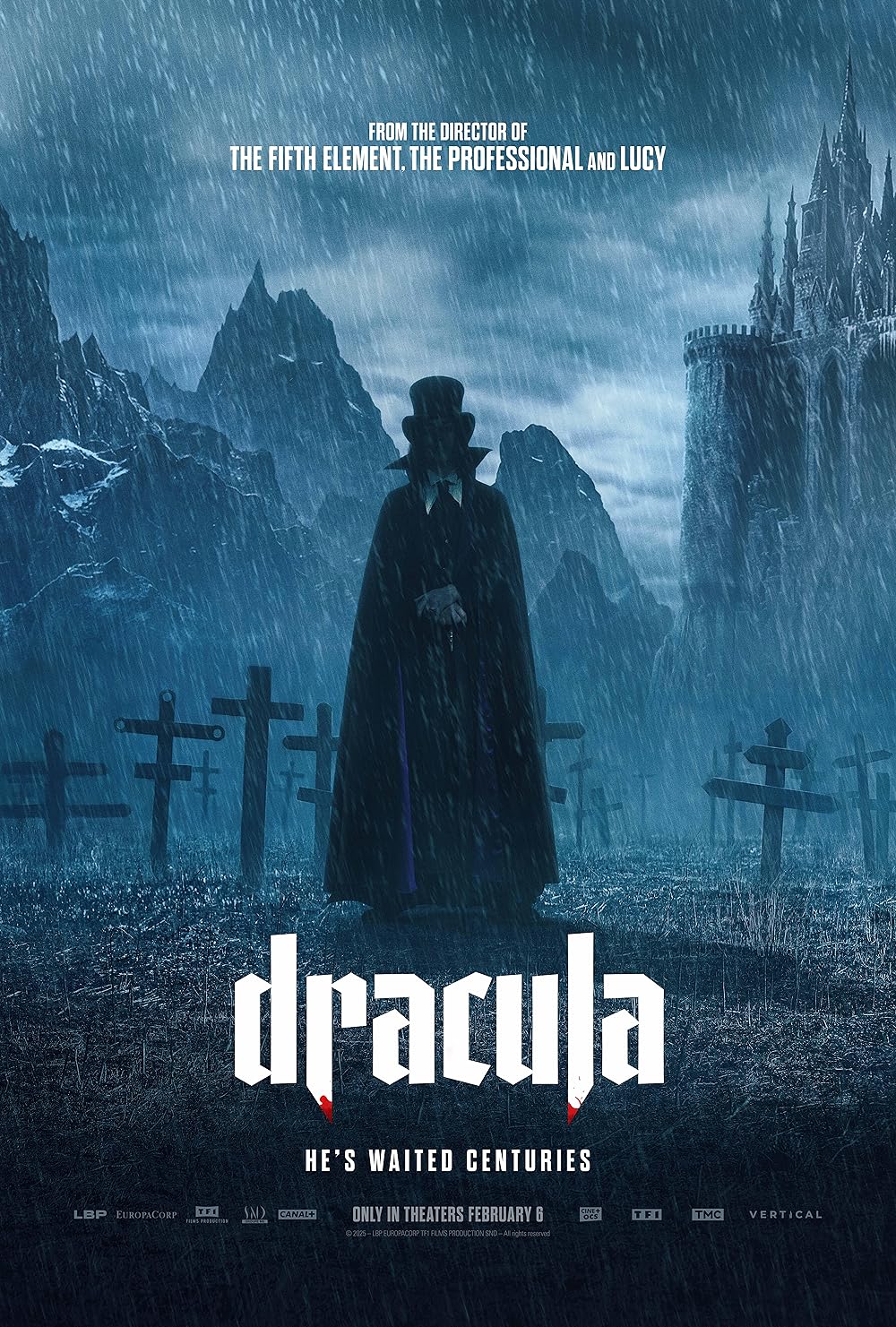
- Starring
- Caleb Landry Jones, Christoph Waltz, Zoë Bleu
- Writer
- Luc Besson
- Director
- Luc Besson
- Rating
- 14A (Canada), R (United States)
- Running Time
- 129 minutes
- Release Date
- February 6th, 2026
Overall Score
Rating Summary
From The Invisible Man, Frankenstein, Wolf Man, Nosferatu, to Dracula, the 2020s have seen a resurgence of classic old Hollywood monster movies—or maybe they never left. Yet, as filmmakers continue to mine from the same gothic tropes, from shadowed castles to obsessive immortal love, few have managed to escape the gravitational pull of their predecessors. Trying to carve out a fresh take on source material over a hundred years old is a Sisyphean exercise that almost always falls short, which makes writer-director Luc Besson’s latest Dracula: A Love Tale all the more elusive. Caught between ambition and incoherence, the film follows too closely in the footsteps of Francis Ford Coppola’s 1992 version, while discarding nearly all the Gothic horror, cosmic romance, and campy maximalism that made that Dracula worth caring about. What’s left is an often monotonous film that dazzles sporadically through scale and rich visuals, yet remains emotionally uneven and tonally unfocused, leaving the whole affair toothless and limp.
The film begins with Prince Vladimir of Wallachia (Jones) returning from battle against the Ottomans to find his wife, Elisabeta (Bleu), dead—a tragedy that drives him to renounce God and embrace vampirism. Fast forward four centuries later, and Vladimir has become Dracula, still obsessively searching for her reincarnation, aided by a small network of vampiric followers and a custom-made perfume designed to lure women to him, explained through a sequence that culminates in a full-blown dance number (yes, really). His mission eventually comes into focus when Parisian solicitor Jonathan Harker (Ewens Abid) arrives to finalize a real estate deal, and Dracula realizes that Harker’s fiancée, Mina, is Elisabeta reborn. After imprisoning Harker in his castle, Dracula rejuvenates himself in one of the film’s more visually astounding sequences, terrorizing a church full of sexually repressed nuns—towering over a pile of them as they fall over themselves trying to drag him down—before heading off to Paris during the centennial celebrations of the French Revolution in pursuit of his lost love. Give or take a dozen uncharacteristically lifeless appearances of Waltz’s unnamed priest filling the Van Helsing role.
It’s sufficient to say that Dracula: A Love Tale is less a bold reinterpretation and more a glossy remix of familiar mythos, taking a few off-kilter, welcomed liberties with the material that initially pay off. It is in the early stretch of world-building where the film is at its strongest, as Besson, cinematographer Colin Wandersman, costume designer Corine Bruand, and the rest of the production design team mostly ignore usual gothic horror aesthetics in favour of capturing the time period with vivid colour and richness, showcasing scale and brief campy moments to suggest an unpredictable maximalist spirit that could burst at any moment—but are, in actuality, sporadic flashes in the pan. Like the tone, crucially, the film struggles to carve out a coherent, compelling Dracula: his threatening presence over Harker dissipates even before his goofy laugh escapes his mouth; his castle includes a pack adorable little Gargoyles that behave with enough broad comedy appeal to seem as if they were designed for a Hunchback of Notre Dame Disney Remake; and yet critically, any attempts to generate sympathy for him as a tragic figure repeatedly get cut short by the fact that he primarily preys on women using his literal, well, date-rape perfume.
That discomfort is especially, though not fatally, heightened by Besson’s own history, having faced accusations of inappropriate sexual behaviour as far back as 2018. Inevitably, the romantic intentions hardly pop, and any potential “director sees themself as the monster” meta-commentary is rendered less charming than it would be in the hands of someone such as, say, Guillermo del Toro in Frankenstein. One could argue the work stands for itself, “death of the author,” but even without the uncomfortable association, what makes Dracula: A Love Tale such a misfire is the lack of a pulse.
Despite taking repeated cues from the reincarnated-lover angle displayed in Francis Ford Coppola’s 1992 Dracula, the film falls flat in the chemistry between Bleu’s Mina/Elisabeta and Jones’s gangly, deeply unsettling performance. Their reunion acts more as a perfunctory “going through the motions” moment of the novel rather than an emotionally charged meeting. Here is a woman who will be revisited by a long-lost love returning 400 years later, but Mina’s presence is so underplayed, and the film’s pedal off of horror and romance leaves the whole execution passionless and terrorless. Ironically, up until this point, the vampire-bitten women in Dracula’s wake have hinted at the film’s inner hypersexuality, but by the time the pivotal moment arrives, any chemistry between the performers plays secondary to Besson’s flashy images. Without a Gary Oldman Dracula or Alexander Skarsgård Nosferatu mustache to sweeten the deal, the relationship becomes much harder to digest.
Dracula dazzles in brief bursts of spectacle—through lavish sets, inventive costumes, and flashes of Besson’s maximalist flair—but these moments are fleeting, undercut by a narrative that lacks focus, a titular vampire who is as difficult to fear as he is to care about, and a central romance that never ignites. In the crowded lineage of classic monster adaptations, Besson’s film secures its place not as a reinvention or bold vision, but as a curious, forgettable footnote: a story that promises terror and passion, yet delivers neither.
Ultimately, the inability of Dracula: A Love Tale to escape comparisons to contemporaries, old and new—through plot and budget echoes in Nosferatu or the familiar presence of Christoph Waltz in Frankenstein—may be its only saving grace; at least it finds a home in the long line of uninspired adaptations firmly lodged inside the half-remembered “oh yeah, there was also this” pantheon.
still courtesy of Game Theory Films/Vertical
If you liked this, please read our other reviews here and don’t forget to follow us on Twitter or Instagram or like us on Facebook.

Discover more from
Subscribe to get the latest posts sent to your email.