

- Starring
- Léa Drucker, Yoann Blanc, Guslagie Malanda
- Writers
- Gilles Marchand, Dominik Moll
- Director
- Dominik Moll
- Rating
- n/a
- Running Time
- 116 minutes
- Release Date (CAN)
- March 20th, 2026 (limited)
Overall Score
Rating Summary
In the history of France, the country has a profound connection to popular manifestations against the political injustices. The most crucial event in the nation’s history, the 1789 French Revolution, was the result of a popular uprising, organized by the bourgeoisie, that overthrew Louis XVI during the Reign of Terror. On the other hand, the modern history of France showcases multiple examples of social manifestations against the unfairness in the public administration. In 2018, the working-class rioted against the high prices of oil, taxes, and the neoliberalism in France in a movement named the Yellow Vests protests. The result was a year and a half of rallies opposing the high cost of living for the lower classes. Still, the movement got its notoriety for the series of violent confrontations between state forces and its members. To that effect, French writer-director Dominik Moll (The Night of the 12th) tackles the internal investigation of police brutality in his Dossier 137 (Case 137), a film that premiered at last year’s Cannes Film Festival.
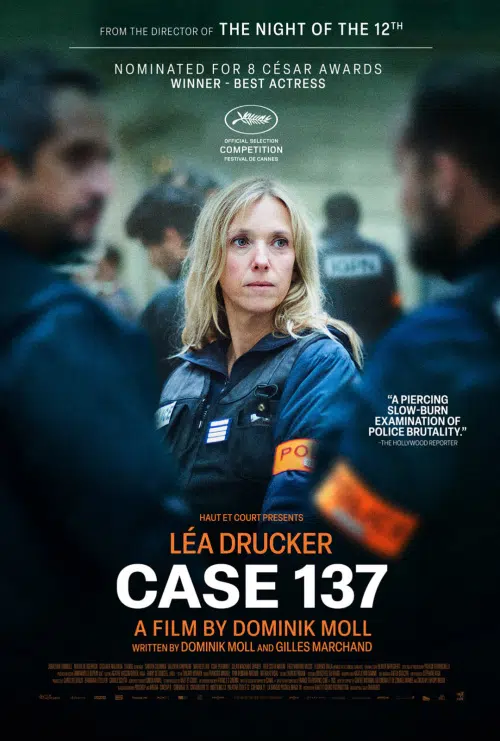
The story follows Stéphanie (Drucker), a former narcotics officer who now works for the internal office (internal affairs) for the French police. She is responsible for investigating any wrongdoing perpetrated by police officers while on the job. After the clashes with a group known as the ‘Yellow Vests’ in Paris, Stéphanie investigates the denunciation of a Joelle (Sandra Colombo), a mother whose twenty-year-old son Guillaume (Côme Peronnet), is in hospital after being shot in the head by a rubber bullet. From there, she, and her team, must search for evidence and try to put a case together against the officers responsible for assaulting the young man.
Employing a procedural format, any credible allegation would trigger an investigation, one involving interviewing witnesses and gathering evidence in the hopes that wrongdoers can be put to justice. Consequently, with the film, Moll leans more on the legal aspect of these proceedings. The director uses Stéphanie, embodied by the presence of Drucker, one of the most prominent actors in modern French cinema, to serves as a guide for audiences, taking them through each step of the process through the lens of this latest incident. Taking on the mission of presenting this mystery and exploring the moral ambiguity within Stéphanie’s actions, her colleagues, including her ex-husband and his current partner, blame her for diminishing the reputation of the department and for hurting the efforts of the police in the court of public opinion.
On the other hand, Stéphanie was certainly feeling the pressure both internally and externally, trying to solve such a brutal case. Finding herself in a fascinating moral dilemma, as a mother, she feels Joelle’s pain but in the same sense, she cares about the opinions of those closest to her. Yet, the film’s biggest flaw lies in its poor execution by Moll, whose direction delivers a rather boring and poorly paced film bogged down with bureaucracy. That being said, it still offers up a close look at the legal process behind the French apparatus’ policing of itself, of hurting its own population, and the limits on the actions of public officers in order to keep them accountable to civilians. Even then, the director’s approach leads this nuanced subplot to lose steam.
In the end, all of this amounts to a near two-hour film that feels imminently long and tiresome. Star Léa Drucker, meanwhile, does not have enough material to showcase her range, as a woman caught between her values and the pride of being a police officer. In spite of its flaws, to its credit all, it delivers a closer look at the French legal system and the inner resolutions of its own brutalities. However, the film lacks the appropriate rhythm for audiences to comprehend the nuances of its subject matter, resulting in a mediocre French government drama, and one similar to the many efforts released as of late.
still courtesy of Film Movement
If you liked this, please read our other reviews here and don’t forget to follow us on Twitter or Instagram or like us on Facebook.

Brazilian film writer. He is also a producer and executive producer for Zariah Filmes. Member of the International Film Society Critics Association (IFSCA), International Documentary Association (IDA), and Gotham and Media Film Institute.
Discover more from
Subscribe to get the latest posts sent to your email.